Every beginner reaches this fork within the first month: the Instagram feed is full of loose, bouncing, joyful modern calligraphy, while the books and the serious-looking courses teach copperplate — strict, slanted, two centuries old, and visibly related to the writing on your grandmother's wedding invitations. Which to learn? The honest answer is that this is a temperament question wearing a technique costume — and that the fork matters less than the feed suggests, because both roads are paved with the same seven strokes. But the roads do feel different to walk. Here's the real comparison.
Copperplate: the grammar
Copperplate — descended from the English round hand of 18th-century writing masters, refined into American Engrosser's Script — is a rule system. The slant is 55 degrees, every time. The x-height, ascender, and descender proportions are fixed ratios. Each letter has a canonical construction, stroke by stroke, and mastery means your hundredth a is indistinguishable from your tenth. It is usually written with an oblique holder (that odd flanged tool built to hold the nib at the slant your wrist can't comfortably reach), on guidelines, slowly, forever.
What that discipline buys you: a trained eye. Copperplate students learn to see — proportion, spacing, pressure, consistency — because the rules make every deviation visible. It is also self-graded: hold your page against the exemplar and the page tells you the truth. People who thrive on measurable progress and objective standards find copperplate deeply satisfying, almost meditative. People who chafe at rules find it dental.
Modern: the poetry
Modern calligraphy is pointed-pen (or brush-pen) script with the rulebook deliberately loosened: baselines bounce, slant wanders expressively, letterforms stretch and compress for rhythm, and the writer's personality is the point. It photographs beautifully, forgives beautifully, and gets beginners to "I made a lovely thing" in weeks rather than months — which matters enormously, because momentum is what carries anyone through the drilling.
The honest caveat: "no rules" is a myth told by people with internalized rules. Good modern calligraphy bounces consistently — its irregularity is designed, not accidental — and the practitioners whose work you admire almost all speak fluent classical structure underneath, whether they trained it formally or absorbed it by ten thousand repetitions. Modern without any structural sense doesn't read as free; it reads as unsteady. The style forgives, but it doesn't excuse.
The quiet truth: the drills don't care
Underneath the fork, the mechanics are identical: thick downstrokes, hairline upstrokes, the same seven foundation strokes, the same pressure control, the same ovals. A month of drills serves either destination completely. So the real question isn't "which script?" — it's "which teacher does your temperament need?"
Choose by temperament
- Choose copperplate first if: you like rules, rubrics, and visible mastery curves; you want wedding-grade formal envelopes eventually; the historical lineage is part of the romance; "correct" is a satisfying word to you.
- Choose modern first if: you need early wins to stay in the game; your goal is cards, gift tags, and journals rather than formal commissions; brush pens and kitchen-table sessions fit your life; "expressive" beats "exact" in your value system.
- Either way: drill the seven strokes daily, use guidelines, and expect to visit the other side eventually — most calligraphers do, and each script sharpens the other. Copperplate teaches modern its bones; modern teaches copperplate to breathe.
A stationer's confession
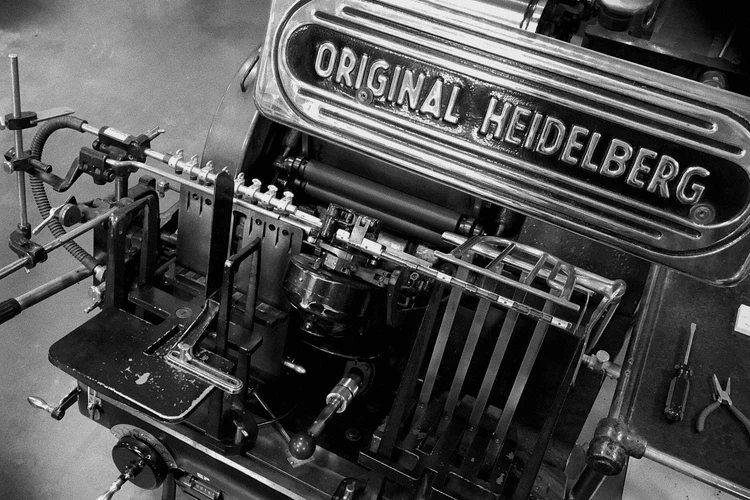
Around this press, the house taste leans classical — our plates and our tags and cards carry more Engrosser's DNA than bounce, because letterpress and copperplate share a temperament: patience, pressure, and the belief that doing a thing properly is its own reward. But the loveliest envelope that ever came through this shop's post was modern script, joyful and irregular and unmistakably one particular human's hand. The style was not the point. The hand was. Pick the road that keeps you walking.
Gear differences are small — copperplate wants the oblique holder sooner (first-kit guide); modern is happiest starting on brush pens (beginner's guide). Whichever you choose, the free practice-sheet maker prints guides for both.