
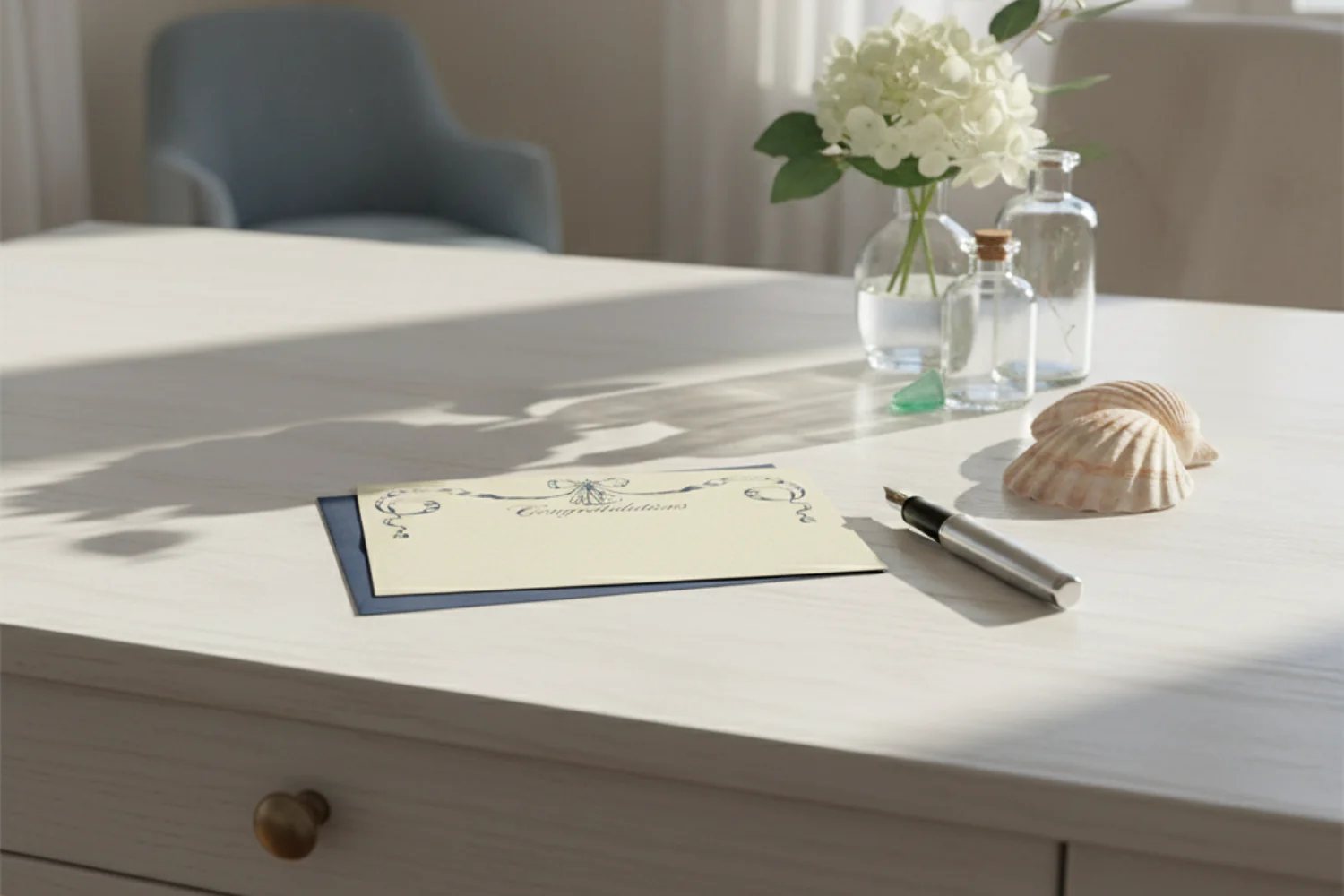
Somewhere in a drawer, most of us keep one: a thank-you note that arrived years ago and refused to be thrown away. It is rarely the longest note we ever received, and almost never the most elaborate. It is simply the one that saw us clearly. This guide is about writing that note — the kind people keep.
The good news is that a memorable thank-you note is not a talent. It is a structure, practiced until it disappears. Five sentences, honestly meant, will outperform a page of borrowed eloquence every time.
Why handwritten still wins
A text arrives instantly and is forgotten at the same speed. A written note has weight — literally. It required paper, a pen, a stamp, and a walk to the postbox, and the recipient feels every one of those small efforts on your behalf. In an age when most gratitude is typed with thumbs, the letterpressed card and the inked signature have become a form of luxury you can post for the price of a stamp.
There is also what writing by hand does to the writer. You cannot dash off a handwritten note. The pen moves at the speed of thought, and somewhere in the second sentence you find yourself actually feeling the gratitude you sat down to perform. The note improves you both.
The five-sentence structure
Nearly every great thank-you note follows the same skeleton. Learn it once and you will never stare at a blank card again.
- Greet them warmly, by name. "Dear Margaret" — never "Hi" on paper, and never a name-less "Hello!"
- Thank them for the specific thing. Name the gift, the dinner, the favor, the weekend. Specificity is the whole game.
- Say what it meant or how you'll use it. This is the sentence people keep the note for — the proof you noticed.
- Look forward. One line that points at the future: the next visit, the return invitation, seeing them at the wedding.
- Close with warmth and sign. "With love," "Yours," "Gratefully" — then your name, in your own hand.
That is the entire machine. Five sentences, one card, done before your tea cools.
The sentence that does the work
The third sentence — what it meant — separates the notes people keep from the notes people recycle. Compare:
"Thank you for the beautiful vase."
"The vase has taken up residence on the kitchen windowsill, and every morning it holds whatever the garden managed overnight — this week, three stubborn dahlias. I think of you at breakfast."
The first is polite. The second is a photograph of your life with their gift in it. You are not writing about the object; you are writing about the object's new home in your days. Do this for a dinner ("I've been trying to recreate that lemon tart all week, without success"), for a kindness ("I don't think I said it at the time, but your phone call that Tuesday held me together"), even for money ("It went straight toward the plane ticket — I'll send a photograph from the top of the trail").
Timing, honestly
The etiquette books say three days for dinner, two weeks for gifts, three months' grace for wedding presents. Here is the truer rule: the best time is now, and the second-best time is still now. A note that arrives late needs exactly one clause of acknowledgment — "I'm long overdue in telling you…" — and not a paragraph of apology. Nobody has ever been offended by a thank-you note that came late. They are only ever offended by the one that never came.
What to avoid
- The gift-card voice. "Thanks so much for everything!" is what a note says when the writer wasn't paying attention. Everything is nothing; name the thing.
- Apologizing for your handwriting. Their eyes will forgive your handwriting. It is yours, and that is the point.
- The essay. A thank-you note is a note. Five sentences honors the reader's kettle; two pages burdens it.
- Waiting for the perfect words. Perfect is the enemy of posted.
Three complete examples
For a dinner: "Dear Priya — Thank you for Friday. The braised lamb was the best thing I've eaten this year, and I've thought twice since about what you said on the terrace regarding brave career moves. Next round is at ours; I owe you both a curry and a rebuttal. With love, Tom."
For a wedding gift: "Dear Aunt Carol — Thank you for the linen tablecloth, which survived its first dinner party on Saturday with only one honorable wine stain. Every table we set with it will be a little bit your doing. We can't wait to have you at the new place this autumn. All our love, Emma & Josh."
For a kindness: "Dear Mr. Okafor — Thank you for staying late Thursday to walk me through the application. You didn't have to, and it changed the outcome. I hope someone did this for you once; I intend to pass it on. Gratefully, Dana."
Keep good cards in the house — a drawer with stamps, a pen that pleases you, and paper worth the words. When the materials are within arm's reach, the note gets written. That is, honestly, half our reason for pressing cards one sheet at a time: not to make gratitude fancier, but to make it easier to begin.