
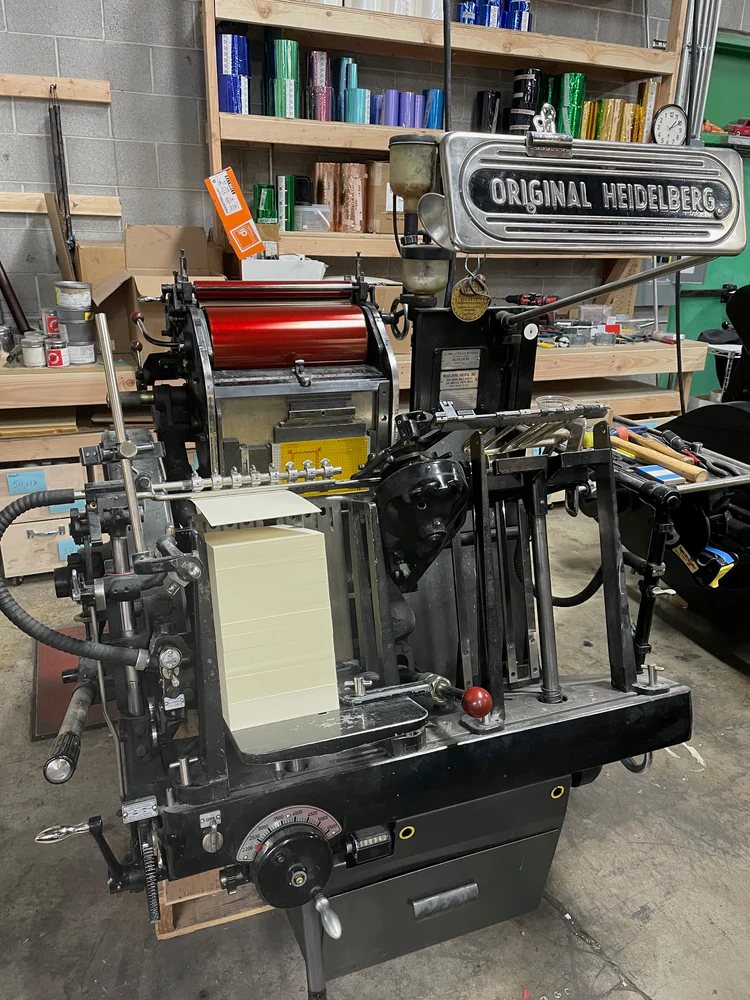
Every craft has one machine that outlived its industry, and letterpress has the Original Heidelberg Platen — universally nicknamed the Windmill. Built in Heidelberg, Germany from 1926 into the 1980s, tens of thousands made, and so absurdly overbuilt that a seventy-year-old example (like the one anchoring our shop, red ink drum and all) is not a museum piece but a Tuesday workhorse. Watch one run and you understand the nickname in three seconds: two steel gripper arms sweep through the air like blades, feeding and delivering paper in one continuous, hypnotic rotation. Here's what's actually happening inside the most mesmerizing machine in printing.
The windmill itself: the gripper ballet
The signature mechanism is the rotating dual gripper system. While one arm is pressing a sheet against the form, the other is already collecting the next sheet from the feed pile — lifted and floated on a puff of air from the blast nozzles, singled by suction. The arms swap roles every cycle: grab, swing, register, press, swing, deliver, grab again — a full exchange with the paper never stopping and the press never waiting. This continuous motion is why a Windmill runs 3,000+ impressions an hour while gentler tabletop platens manage a few hundred, and why watching the feed is genuinely difficult to stop doing. It is also why every Windmill printer develops churchlike respect for the machine: those arms do not pause for fingers, and shop rule one is that hands and the windmill share the air on a strict schedule.
The clamshell: where the impression happens
The Windmill is a platen press: the inked printing plate is locked upright in a steel frame (the chase, in the bed), and a flat steel platen swings up to meet it like a clamshell closing — sandwiching the paper between plate and packing under tons of pressure concentrated across mere square inches of letterform. That concentration is the physics of the deep impression: the same force that would barely dent a full sheet, focused into the thin lines of type, bites decisively into soft cotton. Impression strength adjusts globally at the press and locally in the packing — which brings us to the hour nobody photographs.
Ink's journey: fountain, drum, rollers
Ink starts in the fountain — a trough at the top where a blade meters a film of ink onto a rotating ductor. From there it travels down through a train of distribution rollers (including that big drum — on ours, painted its famous red — that oscillates side-to-side to mill the ink into a perfectly even film) and finally onto the form rollers, which coat the raised plate on every cycle. The whole train exists to solve one problem: sheet #1,500 must receive exactly the ink film sheet #1 did. Color itself is mixed by hand before any of this — knife, slab, and eye (the morning ritual).
Makeready: the invisible half of the craft
Between locking up a plate and printing the first sellable sheet lies makeready — adjusting the packing behind the platen (adding and cutting tissue-thin sheets), setting the guides that register each sheet to the hundredth of an inch, pulling proof after proof until the impression is even corner to corner and exactly as deep as intended. On a fussy job, makeready takes longer than the run. It's the least glamorous and most skilled hour of the day, and the entire difference between letterpress and crushed paper. (What to look for in the result: the reading-a-card guide.)
Why this machine, still
Because nothing has replaced it. The Windmill's combination — commercial speed, surgical registration, and enough platen force to print a whisper or a canyon — is why the letterpress revival essentially runs on rescued Heidelbergs. They were built with the postwar German conviction that a machine should outlive its buyer, and they have, by generations. Ours presses every card in the collection, one gripper-swing at a time; the arms are probably turning as you read this. Spend the full day with it here.